

Modern agriculture is evolving toward full automation and precision farming. One of the most groundbreaking solutions of recent years, redefining the relationship between the operator and the machine combination, is the TIM system (Tractor Implement Management). Kubota has successfully implemented this solution, particularly in its flagship M7 tractor series. What exactly is TIM, how does the certified ISOBUS standard work in the Japanese manufacturer’s implementation, and why does it deliver real fuel and time savings?
Table of contents:
1. What is the TIM system (Tractor Implement Management)?
2. How TIM works in Kubota tractors
3. Example of TIM in operation with a round baler
4. Why invest in machines compatible with the TIM system?
5. FAQ – Frequently asked questions
Advertisement
What is the TIM system (Tractor Implement Management)?
In a traditional setup, the tractor operator decides on every operating parameter: driving speed, PTO speed, and hydraulic control, adjusting them manually to match the attached implement. The TIM system reverses these roles.
TIM is an advanced technology based on the ISOBUS Class 3 standard. It allows the implement (for example, a round baler, forage wagon, or sprayer) to actively control selected tractor functions. Thanks to bidirectional communication, the implement “knows” which parameters it needs at a given moment for optimal performance and automatically sends commands to the tractor.
How does TIM work in Kubota tractors?
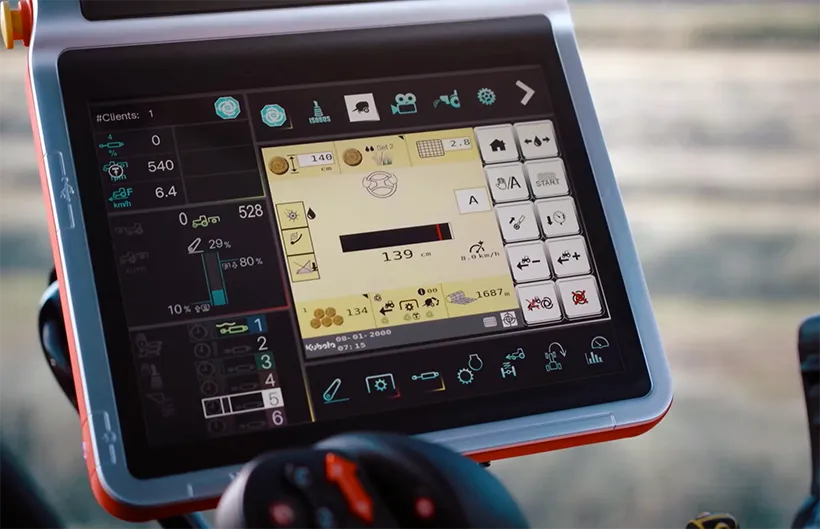
In Kubota tractors, the TIM system integrates with the K-Monitor terminals (7-inch or 12-inch). For the system to operate, two technical requirements must be met:
- The tractor must be equipped with an activated TIM license and an ISOBUS connector.
- The implement must hold an AEF (Agricultural Industry Electronics Foundation) certification for TIM functionality.
Once the combination is paired, the attached implement can take control of four key tractor systems:
- Drivetrain: Adjustment of driving speed (slowing down, accelerating, stopping).
- Steering system: Automatic guidance along a predefined path (if required by the implement).
- Power Take-Off (PTO): Engaging and disengaging the drive and adjusting PTO speed.
- External hydraulics: Control of electrohydraulic valves (e.g., opening the baler tailgate).
Advertisement
Example of using the TIM system with a round baler
One of the best examples illustrating the efficiency of the TIM system in Kubota tractors (e.g. the M7003 series) is operation with a round baler (e.g. Kubota BV):
- The operator enters the windrow.
- The baler monitors the fill level of the baling chamber.
- When the chamber is full, the baler automatically sends a signal to the tractor: “Stop.”
- The tractor smoothly reduces speed to zero.
- The baler initiates the wrapping process with net or twine.
- After wrapping is complete, the baler sends a signal to the tractor’s hydraulics: “Open tailgate.”
- The bale is ejected and the tailgate closes automatically.
- The baler signals readiness, and the operator only needs to confirm the intention to move off (for safety reasons), or – in full automation under suitable conditions – the tractor sets off automatically, increasing PTO speed.
Why invest in machines compatible with the TIM system?
Implementing Tractor Implement Management in Kubota tractors is not just a gadget, but a tool that delivers measurable benefits:
Elimination of operator errors
Operator fatigue after many hours in the field often leads to mistakes—driving too fast in heavy windrows (risk of baler blockage) or delayed reactions to a full chamber. TIM operates in a binary, fully automated manner, eliminating the human factor in repetitive tasks.
Maximum machine productivity
The implement always operates at the edge of its optimal throughput. For example, a forage wagon can automatically slow the tractor when sensors detect a heavier windrow, preventing rotor overload, and accelerate when the crop volume decreases.
Fuel savings
Smooth adjustment of engine speed and driving speed, controlled directly by the implement’s demand, keeps the Kubota engine within its optimal torque range. This avoids unnecessary revving or operation at excessively high PTO speeds.
Higher operator comfort
The operator is no longer a “control driver” but instead supervises the machine’s work. Reducing the number of repetitive actions (such as reaching for hydraulic levers every two minutes) significantly lowers physical and mental fatigue.
Also check: Kubota agricultural tractor technical specifications
Kubota models compatible with the TIM system
Currently, this technology is most extensively developed in tractors designed for heavy field work:
- Kubota M7003 / M7004 Premium KVT: Flagship models with continuously variable transmissions, ideally suited for TIM thanks to seamless speed control from 0 km/h.
- M6002 Series: In higher equipment specifications, offering support for advanced precision farming.
Advertisement
FAQ – Frequently asked questions
Does every Kubota tractor support TIM?
No. The TIM system is mainly available in higher tractor series (e.g. M7003, M7004) equipped with the K-Monitor terminal and the appropriate ISOBUS software license.
Does TIM work only with Kubota implements?
Not necessarily. The system is based on the open AEF ISOBUS standard. If an implement from another brand holds TIM certification (ISOBUS Class 3), it should work with a Kubota tractor, although the highest level of compatibility is typically achieved with same-brand combinations.
Is the TIM system safe?
Yes. The system includes multiple safety safeguards. Despite automation, the operator always has priority and can take over control of the tractor at any time (for example, by pressing the brake or turning the steering wheel), which immediately deactivates automatic control.